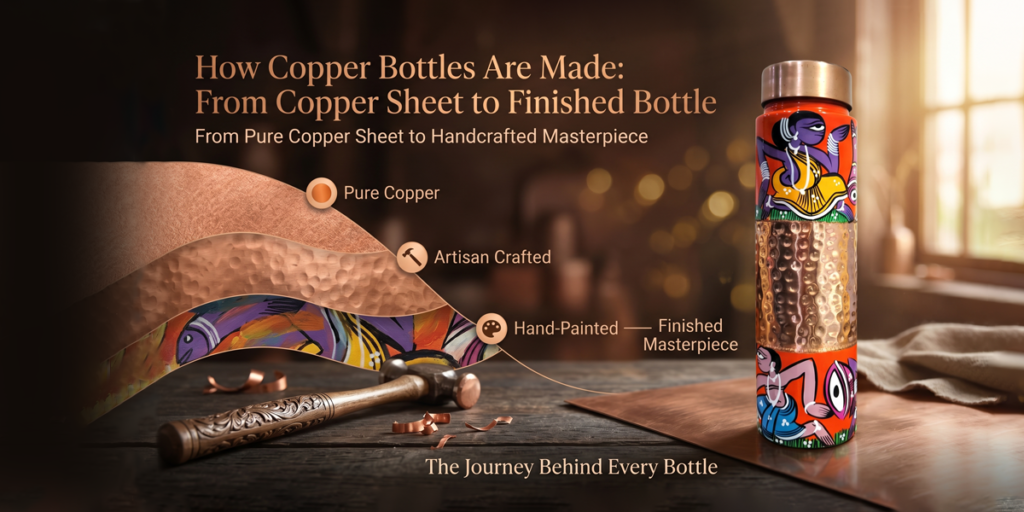
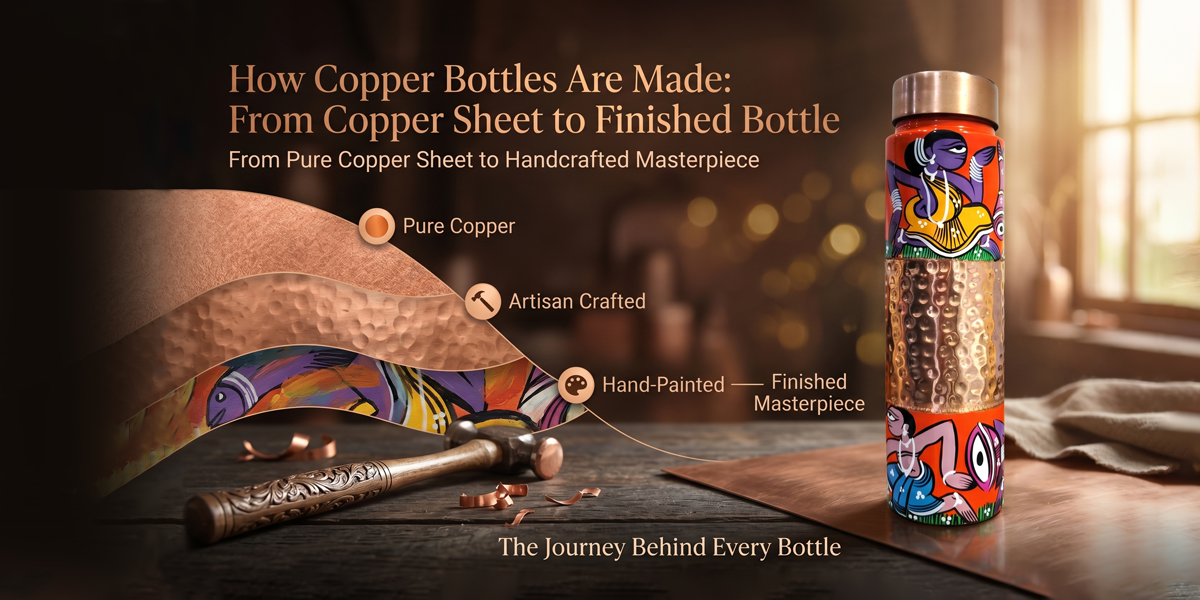
How Copper Bottles Are Made: From Copper Sheet to Finished Bottle
You’ve probably seen those oddly satisfying videos — a flat copper disc spinning on a lathe, slowly stretching into a bottle. They’re mesmerising, but they only show half the story, and most of them show a machine. A copper bottle that lasts decades and carries real character is shaped, finished and often painted by human hands. This guide walks you through the full process, step by step, in plain language — and explains the real difference between a machine-made bottle and a genuinely handmade one, so you know exactly what you’re buying.

How Are Copper Bottles Made? (Quick Answer)
Copper bottles are made from sheets of 99–100% pure, food-grade copper. The sheet is cut into a disc, softened by heating (annealing), then shaped into a hollow body — either by machine (metal spinning on a lathe) or by hand (raising and hammering). The neck is tapered and threaded for a leak-proof lid, the surface is hammered for texture and strength, the bottle is polished, and art bottles are then hand-painted. Finally, each one is leak-tested.
What Copper Bottles Are Made From
Everything starts with the raw material, and this is where quality is won or lost. A genuine bottle begins as a sheet of 99–100% pure, food-grade copper — not copper-plated steel, which looks similar but gives none of copper’s benefits. The thickness matters too: thick enough to last for years and to interact properly with water, but workable enough to shape. If a bottle feels suspiciously light or has a silvery interior, it’s likely plated, not pure.

The Step-by-Step Making Process
1. Cutting the sheet
Large sheets of pure copper are cut into precise circular discs (called blanks), sized for the bottle that will be formed from them.
2. Annealing (softening the metal)
The copper disc is heated to a high temperature in a furnace, then cooled. This is called annealing, and it makes the metal softer and more flexible so it can be shaped without cracking. Copper is repeatedly re-annealed throughout shaping, because working it makes it hard again.
3. Shaping the body — by machine or by hand
This is the step that separates mass-produced from handcrafted:
- By machine (metal spinning / deep drawing): the softened disc is mounted on a lathe and pressed against a mould with a tool that stretches and folds it into a smooth, seamless cylinder. Fast and uniform — every bottle comes out identical.
- By hand (raising and hammering): a traditional artisan slowly hammers the metal over a shaped anvil, coaxing the flat sheet into a curved body. This is slow, skilled work, and the maker must keep the wall thickness even all the way around.
4. Forming the neck
The top of the body is heated again, and the opening is compressed and tapered — by machine or by a skilled hand — to create the narrow neck and mouth. (That narrow-neck shape is also the heart of the traditional surahi vessel.)
5. Hammering the texture
The familiar hammered finish is created by tapping the surface thousands of times with a small hammer. This isn’t only decorative: hammering work-hardens the thin metal, making the bottle noticeably stronger and more dent-resistant.

6. The seam (or no seam)
A machine-spun body is seamless by nature. A hand-formed body may have a seam that must be sealed perfectly to be leak-proof — and a clean, tight seam is a mark of a skilled maker. Premium “seamless” handmade bottles, formed from a single piece, sit at the top of the craft.
7. Threading and the lid
The neck is spun into precise threads so a screw-on, leak-proof lid (usually copper or brass, often with a silicone seal) fits snugly.
8. Polishing — and why the inside stays raw
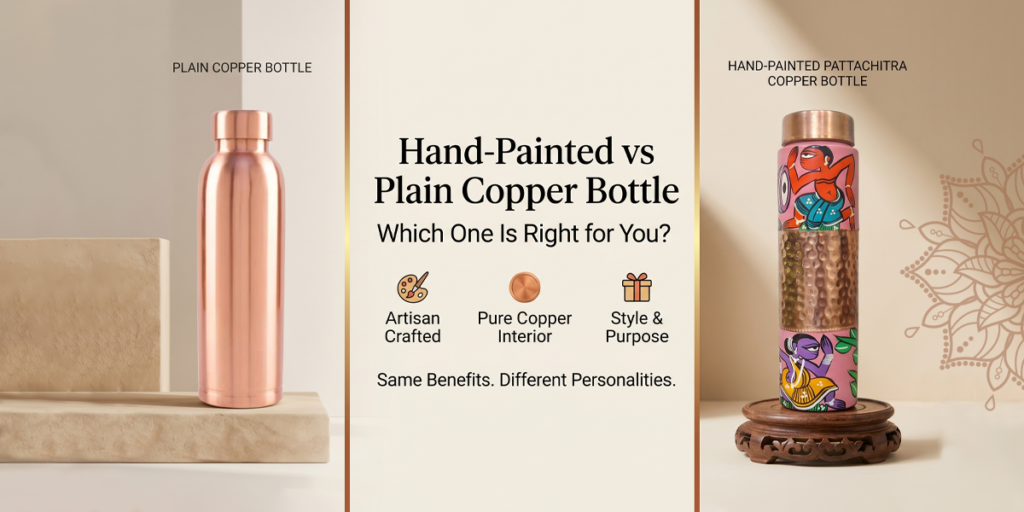
The bottle is polished inside and out to bring up copper’s warm glow, without harmful chemical coatings. One important point most guides get wrong: a good copper wellness bottle should be left raw and uncoated on the inside, so water touches the copper directly. (Some mass-produced bottles add an interior lacquer to stop tarnishing — but that lining blocks the benefits. We explain this fully in hand-painted vs plain copper bottle.)
9. Hand-painting (for art bottles)
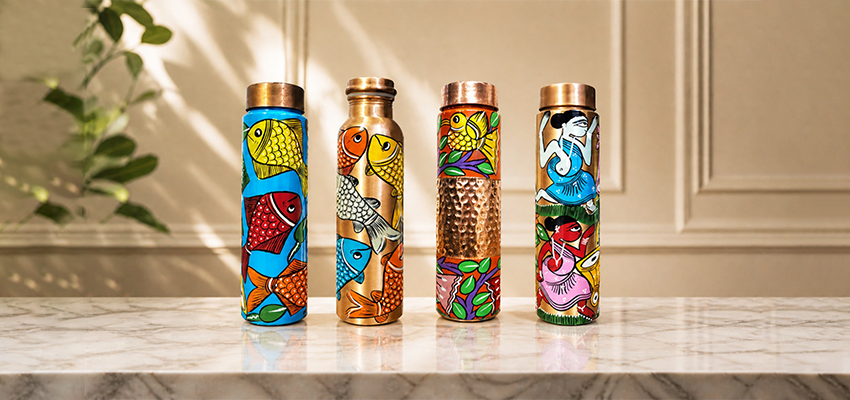
For designs like Dirums’ Pattachitra bottles, a separate painter takes over. Using fine brushes and traditional motifs — fish, flowers, folk scenes — they paint each bottle freehand.
10. Leak testing and final checks
Finally, each bottle is filled or pressure-tested to confirm it’s leak-proof and structurally sound, and inspected to confirm the copper is genuine and the interior uncoated — so it can actually deliver the benefits of copper water.

Machine-Made vs Handmade : The Honest Difference
Both can be good bottles — but they’re not the same thing.
Machine-made (spun) | Handmade (hand-raised / hammered + hand-painted) | |
Speed & cost | Fast, cheaper | Slow, costs more |
Consistency | Identical every time | Each one slightly unique |
Character | Uniform, “perfect” | Visible hammer marks, brush strokes |
Wall thickness | Thin, even | Often thicker, hand-controlled |
Supports artisans | Usually factory labour | Directly supports artisan families |
Best for | Budget, uniform branding | Uniqueness, gifting, owning a craft piece |
Neither is “fake” — but if you want a bottle with a story and a human signature, handmade is the one. If you’re choosing between styles for yourself, our hand-painted vs plain comparison helps.
How to Spot a Genuinely Handmade Bottle
- Look for slight variations: uneven hammer marks, freehand brush strokes, tiny imperfections — proof of a human hand, not a stamping machine.
- Feel the weight: handmade bottles often feel a little heavier and more solid because the copper is thicker.
- Check the finish: genuine copper develops a natural patina over time; a surface that stays mirror-perfect forever may be plated or coated.
- Ask about the copper: a real maker will state the purity (99% pure) and confirm the inside is uncoated.
Why This Matters When You Buy
A handmade bottle carries hours of skilled labour and supports rural artisan families directly — that’s value no machine line can offer. The slight variations aren’t defects; they’re the fingerprint of authentic craft. When you choose a handcrafted pure copper bottle from Dirums, you’re buying that human story along with the bottle, and supporting the artisans who made it.

FAQ — Copper Bottle Benefits
How is a handmade copper bottle made?
A handmade copper bottle starts as a sheet of pure copper, cut into a disc and softened by heating (annealing). An artisan hammers it over an anvil into a body, tapers the neck, and seals any seam to make it leak-proof. The surface is hammered for texture and strength, polished, often hand-painted, fitted with a threaded lid, and leak-tested before it’s ready.
What’s the difference between a machine-made and a handmade copper bottle?
A machine-made bottle is spun on a lathe into a seamless, uniform shape — fast, cheaper, and identical every time. A handmade bottle is shaped and hammered by hand and often hand-painted, so it’s thicker, unique, and carries visible craftsmanship. Both can be good quality, but handmade bottles support artisan families and give you a one-of-a-kind piece rather than a mass-produced one.
Are copper bottles seamless or do they have a seam?
Both exist. Machine-spun bottles are seamless because they’re stretched from a single disc. Hand-formed bottles may have a seam that’s carefully sealed to be leak-proof — and a clean, tight seam is a sign of a skilled maker. Some premium handmade bottles are also seamless, formed from one piece, which represents the highest level of the craft.
How can I tell if a copper bottle is genuinely handmade?
Look for small, natural variations — slightly uneven hammer marks, visible freehand brush strokes on painted bottles, and tiny imperfections that machines don’t produce. Handmade bottles usually feel heavier and more solid, develop a natural patina over time, and come from sellers who clearly state the copper purity. Perfectly identical, very light, or mirror-permanent bottles are usually machine-made or plated.
What kind of copper is used to make copper bottles?
Quality copper bottles are made from 99–100% pure, food-grade copper, with no other metals or alloys. Pure copper is what gives the bottle its antibacterial action and wellness benefits. Avoid copper-plated steel, which only has a thin copper layer over another metal and offers none of the benefits — and check that the interior is raw, uncoated copper, not lined with lacquer.
Conclusion
A copper bottle is the product of real process and, at its best, real craft — cutting, annealing, shaping, hammering, polishing, and often hand-painting. Knowing how it’s made helps you value the work, spot genuine quality, and understand why a handmade bottle costs a little more. If you’d like a piece made the traditional way, explore the artisan-made Dirums copper bottle collection.