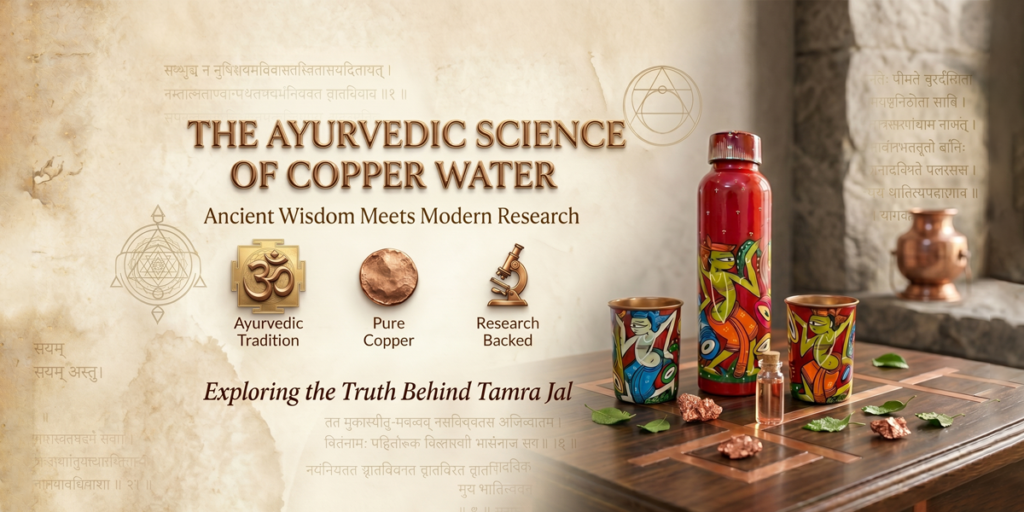
The Ayurvedic Science of Copper Water (Tamra Jal): What Research Actually Says
For thousands of years, Indian households have filled a copper vessel with water at night and sipped it at dawn. Ayurveda calls this Tamra Jal — copper water — and treats it as a daily tonic. But in 2026, the real question is sharper: how much of this ancient wisdom does modern science actually back? This guide gives you the honest answer — the real Ayurvedic theory explained simply, then a clear verdict on what research confirms, what’s plausible, and what’s still pure tradition.

The Honest 30-Second Answer
Ayurveda got the big idea right: storing water in copper genuinely makes it safer to drink — modern studies confirm copper kills harmful bacteria. Copper is also a real nutrient your body needs. But the deeper Ayurvedic claims — balancing doshas, aiding many conditions — are traditional wisdom that science hasn’t fully tested yet. And the disease “cures” you’ll read about online actually refer to purified medicinal copper, not the water. So: enjoy Tamra Jal as a safe, time-tested daily ritual — not as a treatment for illness.
What Ayurveda Actually Says About Copper
Most articles skip this part. Here’s the real theory, in plain language.
In Ayurveda, copper is called Tamra, and it’s classed as a Rasayana — a rejuvenating substance. Water rested in a copper vessel (Tamra Jal) is believed to help balance the body’s three doshas: Vata (air/movement), Pitta (fire/metabolism) and Kapha (earth/structure).
The classical texts describe copper with specific qualities that explain why it was valued:
- Ushna (hot potency): copper is considered “heating,” which is why it’s traditionally said to pacify the cooler Vata and Kapha doshas.
- Lekhana (scraping action): a unique property believed to “scrape away” excess — fat, phlegm, and clogging in the body’s channels.
- Tarpana (nourishing): at the same time, it’s seen as nourishing to the tissues.
Copper appears across foundational texts like the Charaka Samhita and later Ayurvedic literature, and the instruction is consistent: store boiled-and-cooled water in a copper vessel before drinking, ideally for several hours, to infuse it with copper’s micro-particles. This is the same logic behind every modern Dirums copper bottle — a portable version of the old copper lota.

The Distinction Nobody Explains: Copper Water vs Copper Medicine
Here’s where almost every blog misleads you. You’ll see claims that “copper treats arthritis, anaemia, skin disease, even cancer.” Those claims come from Ayurvedic texts — but they describe copper bhasma, a purified, processed medicinal ash, not the water in your bottle.
Why this matters: Ayurveda is clear that raw copper has eight toxic properties (tamra doshas), so before copper is used as internal medicine, it must go through strict purification (shodhana) and incineration (marana) processes. Only then is it given to treat specific diseases, under guidance.
Copper water is different and much gentler. It simply gives you tiny, safe amounts of copper plus the purifying effect — which is exactly why the texts call water-storage the “easiest and safe” way to get copper’s everyday benefits. So when you read that copper “cures” something, remember: that’s the medicine, not your morning glass. Your Tamra Jal is a wellness ritual, not a prescription.

What Modern Research Confirms
The science, sorted honestly into three buckets. (For the full, practical list of everyday benefits, see our dedicated guide on the benefits of drinking water from a copper bottle — this article focuses on the evidence, not the benefits list.)
✅ Confirmed: copper purifies water (the strongest evidence). This is the claim with real proof. In a 2012 study in the Journal of Health, Population and Nutrition, water deliberately contaminated with dangerous bacteria — including E. coli, Salmonella, Shigella and the cholera bacterium — had no recoverable bacteria after sitting in copper for about 16 hours at room temperature. Researchers call this “contact killing.” Crucially, the copper that leached into the water stayed well within the WHO safe limit of 2 mg per litre. Ayurveda’s “copper cleans water” instinct was right.
✅ Confirmed: copper is an essential nutrient your body needs. Copper is the body’s third most common trace mineral and a required cofactor for several enzymes — including ceruloplasmin (helps your body use iron), lysyl oxidase (builds collagen and elastin), tyrosinase (makes melanin), and superoxide dismutase (an antioxidant). So the building blocks behind Ayurveda’s wellness claims are biologically real — though the adult daily need is tiny (about 900 micrograms, per the NIH Office of Dietary Supplements), and most people aren’t deficient.
🤔 Plausible but not proven for copper water specifically: Better digestion, stronger immunity, glowing skin. Copper is involved in all these pathways, but large human trials on copper water (versus copper from food) are still limited. Reasonable — not guaranteed.
📜 Traditional only (not clinically proven): Balancing the three doshas, and “treating” specific diseases. Time-honoured Ayurvedic beliefs, valuable as tradition — but not confirmed by modern clinical studies for copper water.
The verdict at a glance
Claim | Status |
Kills harmful bacteria in stored water | ✅ Confirmed by research |
Provides essential trace copper | ✅ Confirmed |
Supports digestion / skin / immunity | 🤔 Plausible (limited direct proof) |
Balances Vata, Pitta, Kapha | 📜 Traditional belief |
Treats diseases (arthritis, anaemia, etc.) | 📜 Refers to purified copper medicine, not water |
But Do Copper Bottles Actually Work? (The Honest Bit)
You may have read that copper pots work better than bottles. Here’s the truth: the antibacterial effect needs several hours of contact — the research used overnight to 16+ hours. So filling a bottle and sipping it on the go all day won’t sterilise much.
That’s not a flaw — it’s just how to use it. The traditional ritual is overnight storage. Fill your copper bottle at night, let it rest 8–12 hours, and drink it in the morning. Used this way, a good copper bottle does exactly what a pot does. The “bottles don’t work” criticism only applies to people expecting instant purification from a midday refill.

The Ayurvedic Way to Drink It
Keep it simple and traditional: fill a pure copper vessel with filtered water at night, let it rest 8–12 hours at room temperature (never heated or refrigerated, never with acidic drinks like lemon or juice), and drink it in the morning on an empty stomach. Stay moderate, and if you have Wilson’s disease, liver or kidney conditions, are pregnant, or take copper supplements, check with a doctor first.
For the full step-by-step routine, safe daily limits and cleaning method, follow our practical guides on the benefits and correct use of a copper bottle and how to clean a copper bottle.
FAQ
What is Tamra Jal in Ayurveda?
Tamra Jal is the Ayurvedic name for water stored in a copper vessel, usually overnight. Ayurveda considers copper a Rasayana (rejuvenating substance) and believes Tamra Jal helps balance the three doshas — Vata, Pitta and Kapha — while purifying the water. The traditional practice is to drink it in the morning on an empty stomach as a daily wellness ritual for vitality.
Does science support the Ayurvedic claims about copper water?
Partly. Science strongly confirms that copper kills harmful bacteria in stored water, matching Ayurveda’s “purifying” claim, and confirms copper is an essential nutrient. However, claims about balancing doshas or treating specific diseases are based on tradition and have not been proven by large clinical trials for copper water — so they should be seen as time-honoured wisdom rather than medicine.
What is the difference between copper water and copper bhasma?
Copper water (Tamra Jal) is simply water stored in a copper vessel — it gives safe trace copper plus natural purification, as a gentle daily ritual. Copper bhasma is a specially purified, processed medicinal ash used in Ayurveda to treat specific conditions under expert guidance. The disease-treatment claims you see online refer to bhasma, not the water. Your copper bottle offers wellness support, not medicine.
Can copper water cure diseases like arthritis or anaemia?
No — not the water itself. Those treatment claims in Ayurveda refer to copper bhasma, a specially purified medicinal preparation used under guidance, not the trace copper in your drinking water. Copper water gives gentle nutritional support and safer water; it is a wellness ritual, not a treatment. Always see a doctor for any medical condition.
Why does Ayurveda say copper balances Vata and Kapha?
Ayurveda classifies copper as ushna (heating) in potency, and warming substances are traditionally said to pacify the cooler Vata and Kapha doshas. Copper is also described as having lekhana — a “scraping” quality believed to clear excess fat and toxins. These are classical Ayurvedic concepts that explain the traditional reasoning; they are not confirmed by modern clinical trials.
Conclusion
The most honest takeaway: Ayurveda was remarkably right about the fundamentals — copper makes water safer, and copper is a nutrient the body truly needs. The deeper claims are promising tradition, not proven medicine, and the disease “cures” belong to purified copper preparations, not your morning glass. Used the traditional way — overnight storage, a morning glass, in moderation — Tamra Jal is a safe, beautiful, 5,000-year-old habit worth Keeping.
Begin yours with a handcrafted pure copper bottle from Dirums, made the way the tradition intended.