Souvenir vs Memento: What’s the Difference and Which One Should You Buy?
What is a Souvenir?
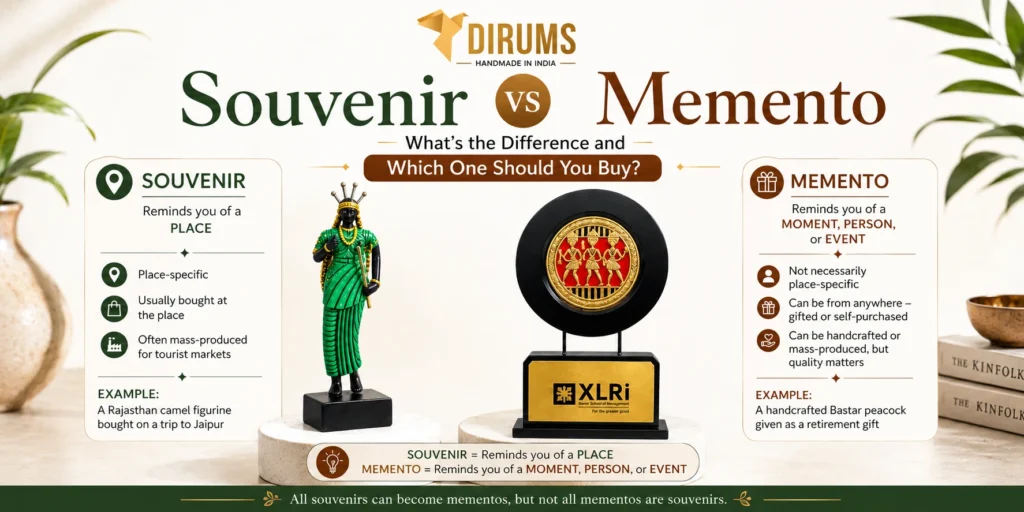
The word souvenir comes from French, meaning ‘to remember.’ A souvenir is typically an object bought as a reminder of a place you visited. Think of a small Eiffel Tower replica bought in Paris, or a miniature Taj Mahal from Agra.
Souvenirs are place-specific — they represent a location, a trip, or a travel experience. They are often mass-produced and sold in tourist areas.
- Purpose: To remember a place or travel experience
- Origin: Usually bought at the place being remembered
- Production: Often mass-produced for tourist markets
- Example: A Rajasthan camel figurine bought on a trip to Jaipur
What is a Memento?
The word memento comes from Latin, meaning ‘remember’ or ‘remind.’ A memento is an object that serves as a reminder of a person, event, or experience. Unlike souvenirs, mementos are not necessarily place-specific.
A memento could be a gift given at a corporate event, a keepsake from a wedding, a handcrafted figurine gifted to a retiring colleague, or a cultural object bought to celebrate an occasion.
- Purpose: To remember a person, event, or experience
- Origin: Can be from anywhere — gifted or self-purchased
- Production: Can be handcrafted or mass-produced, but quality matters
- Example: A handcrafted Bastar peacock given as a retirement gift
Simple Way to Remember the Difference
|

Where the Lines Blur
In everyday use, especially in Indian gifting culture, the two words are used interchangeably — and that is perfectly fine. When Dirums calls our products ‘handcrafted mementos,’ we mean objects that are meant to be kept and remembered — whether as a reminder of a trip to India, a corporate event, a festival, or simply the joy of owning a beautiful handcrafted piece.
In the context of Indian tribal art, both terms apply because the objects:
- Represent a specific region or culture (souvenir function)
- Are gifted on specific occasions and carry personal meaning (memento function)
Which One Should You Buy — Souvenir or Memento?
Buy a Souvenir If:
You are on a trip and want to bring back something that represents the place
You want a small, affordable gift for multiple people
You are at a tourist location and want to buy something quick
Buy a Handcrafted Memento If:
You want something meaningful that will be kept for a long time
You are gifting for a specific event — corporate, wedding, religious, personal
You want to give something that represents Indian culture and craftsmanship
You want the gift to carry a story and have artistic value
You want it to be customizable

Handcrafted Mementos: The Best of Both Worlds
The best handcrafted mementos work as both souvenirs and keepsakes. A Bastar tribal peacock, for instance, reminds the recipient of Chhattisgarh’s tribal culture (souvenir function) while also serving as a personal reminder of the event or person who gave it (memento function).
At Dirums, our entire collection of handcrafted mementos — from Bastar iron art to Dhokra brass pieces to Pattachitra decorated objects — is designed to be both culturally representative and deeply personal.
Conclusion
Whether you call it a souvenir or a memento, what matters most is the quality, the story, and the meaning behind the object. A handcrafted tribal piece from Dirums gives you all three — it is beautiful, it is meaningful, and it carries the living tradition of Indian folk art.
The next time someone asks you whether to buy a souvenir or a memento — tell them to buy a handcrafted one. Because the best keepsakes are the ones made by human hands.
Shop Now
How Often Should You Clean Your Copper Bottle?
Daily use: Rinse it every day with warm water.
Weekly cleaning: Deep-clean it once a week to remove stains or patina.
Occasional use: Clean it before and after storing it for long periods.
Avoid leaving water in the bottle overnight or for more than 6 to 8 hours if you won’t be drinking it soon.